000386 – Copy
Category : Casino
How Is RTP Calculated in Online Casino Games?
Imagine you’re at a bustling casino, lights flashing, the clink of chips echoing, and you’ve just landed on a new slot machine. A reference like casino de mino can provide another useful angle on the subject. You notice a small sticker on the side that reads “RTP 96.5%.” That figure isn’t a mystery; it’s a number that has been carefully calculated by the game’s developers to reflect the expected return over time. If you’re curious about how the numbers behind the reels are set, you can check the details on the casino’s official page: . Knowing where the RTP comes from helps you decide whether to spin or move on.
Rtp, Total, and the User Experience
RTP stands for Return to Player. In practice, it’s the ratio of the total amount paid back to players over the long run compared to the total amount wagered. For a casino game that’s been run thousands of times, the RTP is calculated by summing every payout and dividing that sum by the total stake. The result is expressed as a percentage, so an RTP of 95% means that, on average, a player will recover ninety‑five cents for every dollar they bet over a very large number of spins.
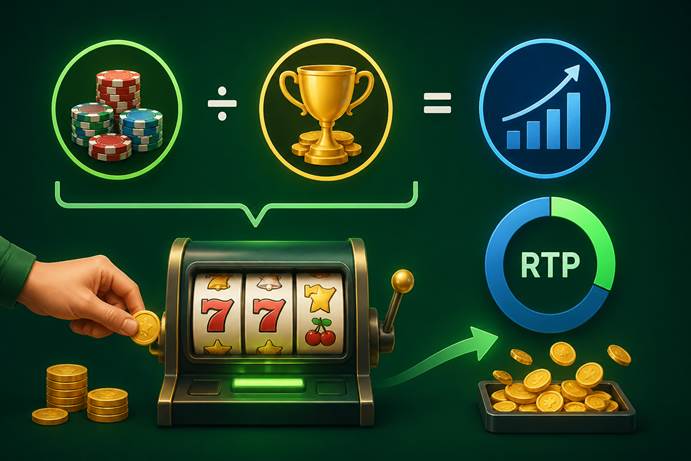
The calculation starts with the paytable, the list that tells you how many credits you receive for each combination of symbols. Each line on the paytable is assigned a probability based on the number of ways it can appear, which the software uses to determine the expected value of a single play. By multiplying the payout by its probability and adding all those products together, the game’s expected return is found. That figure is then divided by the bet size and multiplied by one hundred to give the final RTP percentage.
• In practice, it’s the ratio of the total amount paid back to players over the long run compared to the total amount wagered
• For a casino game that’s been run thousands of times, the RTP is calculated by summing every payout and dividing that sum by the total stake
• The result is expressed as a percentage, so an RTP of 95% means that, on average, a player will recover ninety‑five cents for every dollar they bet over a very large number of spins
• That figure is then divided by the bet size and multiplied by one hundred to give the final RTP percentage
• The remaining 2% is the house edge, the margin that keeps the casino profitable over time
• A single session of a high‑RTP game can still end in a loss, just as a low‑RTP game can produce a lucky streak
The Role of Casino Experience
Take a classic three‑reel slot as an example. Suppose the machine has a 1,000‑way paytable and offers a 98% RTP. If you bet one unit per spin, the software will have been programmed so that the sum of all payouts over 1,000 spins equals 980 units. In other words, after a thousand plays, the casino will have paid out 98% of the money wagered. The remaining 2% is the house edge, the margin that keeps the casino profitable over time.
For players, the takeaway is that RTP is a long‑term measure. A single session of a high‑RTP game can still end in a loss, just as a low‑RTP game can produce a lucky streak. Understanding that the figure is calculated over millions of hands or spins, not a handful, helps set realistic expectations. It also explains why a casino can offer a game with a 99% RTP and still earn revenue: the 1% difference is enough to cover operating costs and profit when aggregated across all patrons.
Before a game reaches the casino floor, developers run extensive simulations. They generate millions of virtual spins, record every outcome, and calculate the resulting RTP. If the result deviates from the target, they tweak reel weights or adjust paytables until the calculated RTP aligns with the desired percentage. Regulatory bodies may also audit the software to confirm that the published RTP matches the internally calculated figure, ensuring that the casino’s claims are honest.
Each Through the Lens of End
In the end, the numbers you see on a casino’s display are the result of meticulous calculation. Knowing how RTP is derived gives you a clearer lens through which to view each spin, each card dealt, and each decision you make. It reminds you that while the thrill of the game is real, the odds are set by a formula that favors the house over the long haul, and that every wager is part of a larger statistical framework.